Mixing ratio calculator
Split a known batch into Part A and Part B. Match the measurement basis on your exact product label.
Choose the basis
Changing the basis clears the previous amount and ratio. Enter the values for the new measurement basis.
Presets are arithmetic shortcuts, not product recommendations.
How the split works
Add the two ratio numbers. Part A is total × A ÷ (A + B); Part B is total × B ÷ (A + B). Use one measurement basis throughout.
| Ratio | Total batch | Part A | Part B |
|---|---|---|---|
| 1:1 by weight | 200 g | 100 g | 100 g |
| 2:1 by weight | 300 g | 200 g | 100 g |
| 4:1 by weight | 500 g | 400 g | 100 g |
| 100:43 by weight | 286 g | 200 g | 86 g |
| 2:1 by volume | 150 mL | 100 mL | 50 mL |
Already measured Part A?
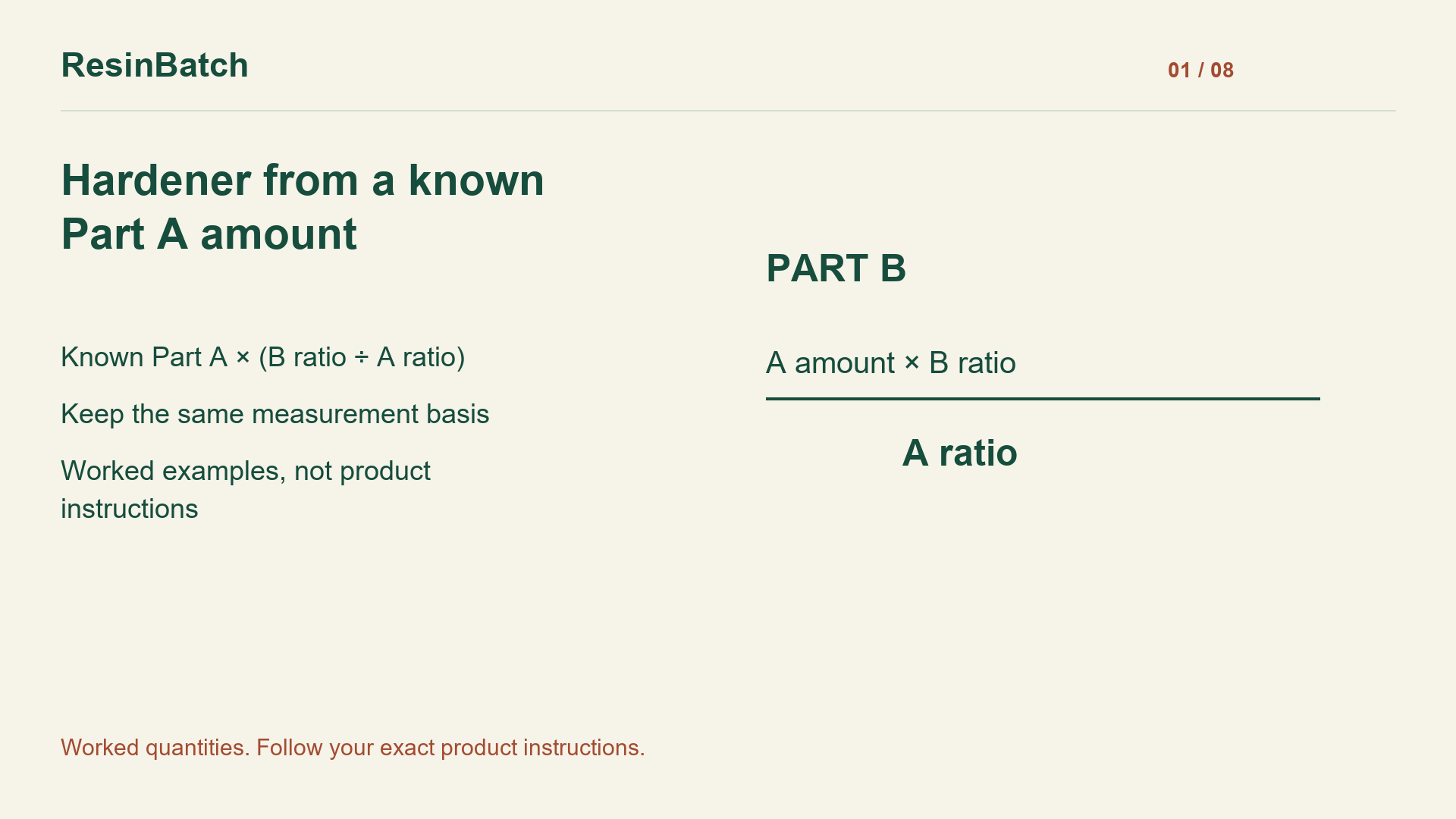
The input above expects the finished mixed total. If you have already measured A, calculate B = A × ratio B ÷ ratio A instead. At a product-specified 2:1 by volume, 80 mL A needs 40 mL B, making 120 mL total. Entering 80 mL as the total would give 53.33 mL A + 26.67 mL B, which answers a different question.
For an existing 200 g A amount at 100:43 by weight: B = 200 × 43 ÷ 100 = 86 g, and the total is 286 g. The printable ratio chart includes this existing-component formula.
Watch: calculate hardener from an existing Part A amount
A 3-minute worked example: 180 g of Part A at 2:1 by weight needs 90 g of Part B. To check that split above, enter the 270 g combined total. The video also compares a 100:43 weight ratio with a separate volume example. Original diagrams and calculator screenshots, with synthetic English narration and captions; no physical mixing demonstration.
Watch on YouTube · Get the ratio chart
Playing here loads YouTube’s player. No YouTube player is loaded until you choose Play. Video privacy details.
Measure the split without losing track
Check which bottle your product calls A and which it calls B. If its instructions permit sequential weighing in one container, tare the empty container first. For the 300 g, 2:1 weight example, add 200 g A, then add B until the scale reads 300 g total. If you tare again after A, the B target is 100 g. Follow the manufacturer’s measuring and mixing method.
Use the specified ratio rather than adding extra hardener to change cure time; WEST SYSTEM explains why changing the ratio can prevent proper cure.
Need to find the total first?
The resin mold calculator works out liquid volume from cavity dimensions and piece counts. A volume ratio and a weight ratio may have different numbers; read the measurement guide before switching methods.